Photo Detective Work, With Sources
How to Date Old Photos
Quick answer
You can usually tell how old a photo is, to within a decade, from the print itself. A lab date on the border or back, the maker’s name printed on the paper, the edge and the shape each bracket an era. The scene and the faces narrow it. Trust a year only when two or three clues agree.
- Turn it over first: handwriting on the back beats every other clue.
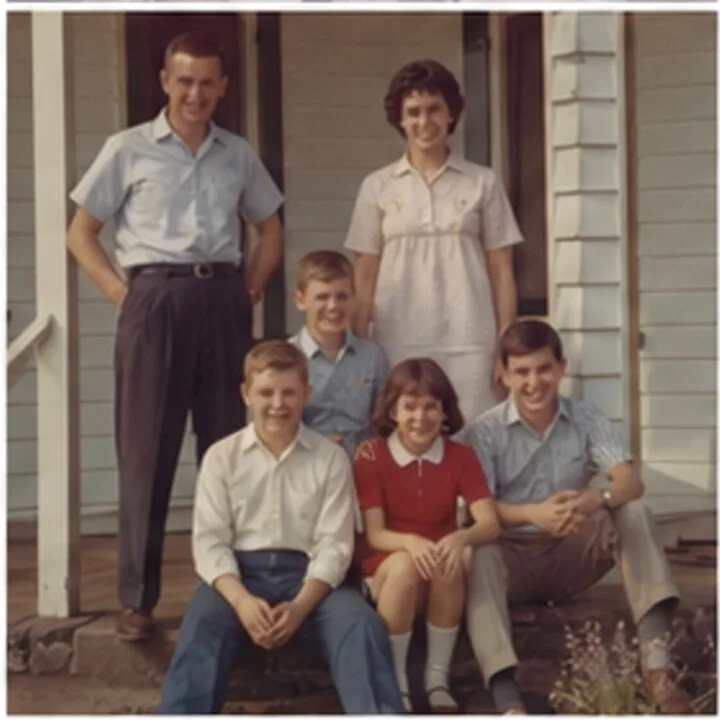 JUN 68
The lab’s date
Clothes & hair
Square: 1963 or later
JUN 68
The lab’s date
Clothes & hair
Square: 1963 or later
One print, five of the seven clues. Jump to any clue:
Clue 1 · the lab’s own marks
Look for the Date the Photo Lab Left Behind
Where the lab put its date tells you the era.
-
1942 to the 1960s
A stamp on the back
Kodak backstamps from these years often include the processing date[1].
-
About 1952 onward
A printed date on the front border
Machines printed the processing month and year on the white border[2]; on color prints, from 1960[1].
-
The 1970s
The border disappears, and the date with it
Labs went borderless, partly because borders discolored[1]. No border usually means the 1970s or later.
-
Late 1970s onward
Machine printing returns to the back
Some labs printed the processing date and exposure details on the back[1].

A lab date is the processing date, not the day the shutter clicked. Film often sat for months or years first[9], so read it as “taken on or before.”
Clue 2 · the paper itself
Decode the Kodak Backprinting
Turn the print over. Kodak changed this wording in documented waves.
Black-and-white prints[5]
-
Late 1920s to late 1940s
The single word Velox, no other decoration: American-made paper of this era.
-
About 1950 to the mid-1960s
After about 1950 the backprint stacked the words Kodak / Velox / Paper.
Color prints: Kodak’s documented wording waves[3][4]
-
October 1958 to November 1961
The circular “penny seal” emblem.
-
1961 to 1972
Selective underlining begins mid-1971.
-
May 1972 to January 1991
“THIS PAPER MANUFACTURED BY KODAK,” overlines added from mid-1980.
-
1991 to 1995
The shorter wordmark.
-
July 1995 to April 1997
The Olympic sponsorship wording.
A backprint dates the paper, not the print, and comparatively few papers are marked at all[5]. Use it to tell a 1960s print from a 1980s one.
Clue 3 · edges and surfaces
Read the Edge and the Surface of the Print
Deckle edges bracket the mid-century
The wavy, scalloped edge peaked in the mid-to-late 1950s and fell away fast in the early-to-mid 1960s[2].
A silk-textured color print is a narrow marker
Kodak introduced matte and silk surfaces in 1968[4]. Before that, color fiber prints came glossy only[4].
How do we know these dates?
- Deckle edges: a study of 321 dated deckle-edge snapshots puts the scalloped edge’s run at the 1930s through the early 1960s[2]. Machine dies cut the wavy edge, not a true papermaker’s deckle, which is why it is so uniform.
- Silk surfaces: silk was the surface of choice in the early 1970s, was abruptly displaced in 1976 and fell to about 1% of photofinishing prints by 1977[4]. So a textured color snapshot most likely sits in the 1968 to 1976 window.
Clue 4 · shape and size
Let the Print’s Shape Name the Camera
Each film format has a launch year, so the shape sets the earliest date.
-
1963 or later
Square snapshot
Kodak’s Instamatic 126 cartridge, 1963: a 28×28 mm square frame[6].
-
1972 or later
Small, grainy rectangle
The pocket 110 cartridge, 1972: a 13×17 mm frame, so prints look soft[6].
-
1982 or later
Disc-camera print
Disc film, 1982: tiny 8×10 mm frames, so prints are small and grainy[6].
-
1996 or later
4×7 or 4×11 panorama
The Advanced Photo System, February 1996, offered both shapes beside 4×6[6].
-
1948 or later
Instant prints
Polaroid, 1948[7], sepia until 1950. Instant color (Polacolor) and peel-apart film: 1963. The white-tab SX-70 square: 1972 on.
-
Print size
About 3½ inches on the short side was the drugstore norm for decades; by 1996 APS treated 4×6 as the default[6]. No authority publishes an exact switchover year: a 4×6 is probably not much earlier than the late 1980s.
Clue 5 · the corner digits
The Orange Date in the Corner Can Lie
It records the moment of the shot, if the camera’s clock was right.
 Scene agrees
 Scene disagrees
-
When cameras printed it
Add-on date backs by 1970; built into compacts from 1983, like Canon’s AF35ML Quartz Date[8]; near-universal on 1990s point-and-shoots.
-
Why it can be wrong
The owner set the clock: a dead battery or an unset date prints a confident, wrong answer. Many models froze at a built-in last year.
Scanning prints yourself? Don’t crop these corners away. The free FrontBack Scanner keeps the whole print, border and all.
Clue 6 · what’s in the frame
Read the Scene Like a Genealogist
-
Cars set a floor
The newest model sets the earliest year; a license plate can give the registration year[11].
-
A calendar is the jackpot
A wall calendar, newspaper or dated sign is the most precise clue in a scene[9].
-
Storefronts and ads bracket eras
Look up a brand logo, a TV set’s shape or a kitchen’s fittings[11].
-
Clothing sets a floor, not a year
The newest-looking outfit is the earliest plausible date; older people kept the styles of their youth.
Clue 7 · the people
The People Are the Calendar
For family photos, the faces you recognize beat every physical clue.




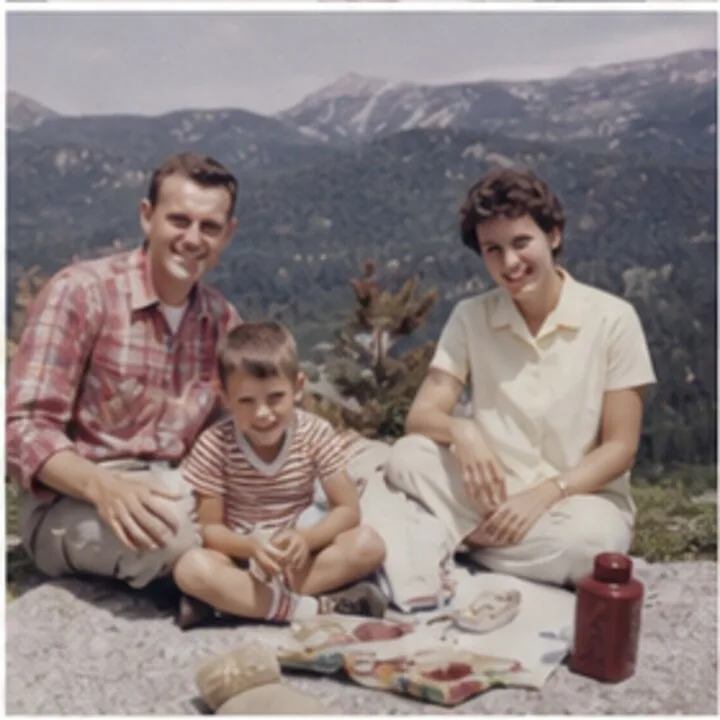
Same face, four birthdays. Each photo dates itself.
-
Do the math
Grandma, born in 1934, looks about ten? Circa 1944, whatever the paper says.
-
Count birthday candles
The candles give the age.
-
Use family papers
Match a wedding dress to the marriage certificate.
-
Read the back
Names and dates in the family’s own hand outrank every other clue.
The method
Make the Clues Vote
No single clue names a year. Draw each one as a range; the answer is where they overlap.
Found a year you trust? Write it into the file. The free Timeline Tagger for Mac and Windows does it: open the folder, type the year, press return. More ways: fixing scanned photo dates.
Before the snapshot era
Holding Something Older Than a Snapshot?
This guide covers roughly the 1930s through the 2000s. Three signs of a 19th-century photograph:
-
A magnet sticks to it
A photograph on a thin metal sheet is a tintype.
-
Mounted on stiff card
A small print on card stock is a carte de visite or cabinet card.
-
A mirror image in a hinged case
A reflective plate in a folding case is a daguerreotype.
These date by the mount, the photographer’s imprint and studio fashion: ask a genealogy specialist or your local historical society.
The shortcut
Let the Software Read the Clues for You
-
One photo, free
The free what year was this photo taken checker gives an estimated year, a likely range and the clues it used.
-
The whole shoebox
Timeline Scan reads handwriting and lab stamps on the backs, lets photos from the same roll date each other, and writes each date into the file for Google Photos, Apple Photos or Immich.
-
How close it gets
On our benchmark prints: within a year of the true date on 96 to 99 of every 100 prints with a printed or handwritten date, and within five years 83% of the time on bare ones. How it’s measured.
-
Share it with family
Family Library keeps the scans in one timeline for $39 a year or a small monthly fee. Up to 20 relatives join free and can add names, dates, places and notes.
Common questions
Dating Old Photos: FAQ
How can I tell how old a photo is?
Read the print first: a lab date on the border or back, the paper’s backprinting, the edge style and the print’s shape and size each bracket an era. Then narrow it with the scene (cars, signs, clothing) and the people. Trust a year only when two or three clues agree; one clue alone is a guess.
What do the marks on the back of an old photo mean?
Most are the paper maker’s wording or the lab’s date. Wording such as “Velox,” “A KODAK PAPER” or “THIS PAPER MANUFACTURED BY KODAK” brackets when the paper was made, because Kodak changed it in documented waves: “THIS PAPER MANUFACTURED BY KODAK” ran from mid-1972 to early 1991[3].
A machine-printed date or exposure code points to the late 1970s or later[1], and a rubber-stamped date is usually the processing date. Handwriting is the family’s own record, and often the most precise clue of all.
How do I date an old photo by clothing?
Read the newest-looking outfit in the frame as the earliest plausible date, not as the year. Young adults track the styles of their moment, but older people often wear the styles of their youth for decades. Add hairstyles and eyeglass shapes, then check against a physical clue, like the print format, before settling on a year.
Is the date printed on a photo the day it was taken?
No. A date on the border or the back is the processing date, when the film was developed and printed. Film often sat in cameras and drawers for months or years, so read it as “taken on or before this date,” sometimes well before: prints from the 1940s can carry stamps decades newer[9].
Only the orange date that 1980s and 1990s cameras burned into the frame records the moment of the shot, and the owner set that clock, so it can be wrong too.
Can AI tell what year a photo was taken?
Yes, with honest error bars. Our free single-photo checker reads the same clues as this guide and got the exact year right 57 times out of 100 on our benchmark prints (72 within one year).
The full Timeline Scan service also reads the backs and dates whole batches together, so photos date each other: the exact year on 74 of the same 100 (86 within one year). The methodology is on the accuracy page.
Show your work
Sources
Every era bracket here was checked against these sources on August 19, 2026. Spot an error? Tell us.
Sources (11)
- Image Permanence Institute (Rochester Institute of Technology), Graphics Atlas: Chromogenic prints, object view. Documents Kodak backstamps with processing dates (1942 to the 1960s), the 1960 introduction of optically printed border dates on color prints, the 1970s move to borderless prints, and late-1970s machine backprinting.
- Anna Krentz, “Snapshots with an edge: a study of the deckle edge in the North American snapshot” (MA thesis, Toronto Metropolitan University). A study of 321 dated snapshots: deckle-edge popularity from the 1930s to the early 1960s peaking in the mid-to-late 1950s, border-printed dates popular from 1952 onward, and rounded corners appearing throughout the sample.
- J. Michael Keirstead with Gawain Weaver and Zach Long, “Ektacolor Paper Backprint Chronology” (2009). The dated table of Kodak color-paper backprints reproduced above.
- Gawain Weaver and Zach Long, “Chromogenic Characterization: A Study of Kodak Color Prints, 1942–2008” (Photographic Materials Group, AIC). States the 1942 Kodacolor launch, the 1960 color-overtakes-B&W crossover in U.S. amateur photofinishing, glossy-only fiber prints 1942–1968, and the 1968–1976 silk-surface window.
- Paul Messier, “Notes on Dating Photographic Paper” (2005). The Velox backprint eras and the method’s limits: backprinting dates paper manufacture, not the print, and few papers are marked at all.
- Kodak, company milestones. Launch years for Kodacolor (1942), the Instamatic 126 cartridge (1963), the 110 pocket cartridge (1972), disc film (1982), and the Advanced Photo System (1996).
- Science Museum Group, Polaroid Land Camera Model 95 (collection record). The first instant-picture camera, dated 1948.
- Canon Camera Museum: the Canodate E (1970, date-imprinting) and the AF35ML Quartz Date (September 1983, built-in date back).
- The Photo Managers, “Be a Photo Detective: Dating Family Snapshots”. The processing-date caution, calendars and headlines as in-scene evidence, from the professional photo-organizer trade association.
- Kodak, “Kodak Photographic Papers” (catalog, October 1949). Lists silk, tweed, tapestry, and suede surfaces across its black-and-white paper lines.
- Legacy Tree Genealogists, “How to Date Old Family Photos”. Worked examples of dating by car model, license plate, and signage.
Photo dating is bracketing, not certainty: a better source or a dated counterexample can move any bracket on this page.
Date One Photo Free, or the Whole Box
The free checker estimates one photo at a time. The full service starts with free photos, reads the backs, dates the batch together, and writes every date into the files themselves.
Try Photos Free