Timeline Tagger · Application help

How to Use Timeline Tagger

Every screen below is the real app, caught mid-job. Step through a guide, or jump to the shortcut you came for.

Free · macOS 14+Version 1.1Check yours in Timeline Tagger → AboutLast updated: August 22, 2026

Before the first photo

Point It at a Folder

Two screens, and then you are dating photos. There is nothing to import and nothing to configure unless your scanner names backs its own way.
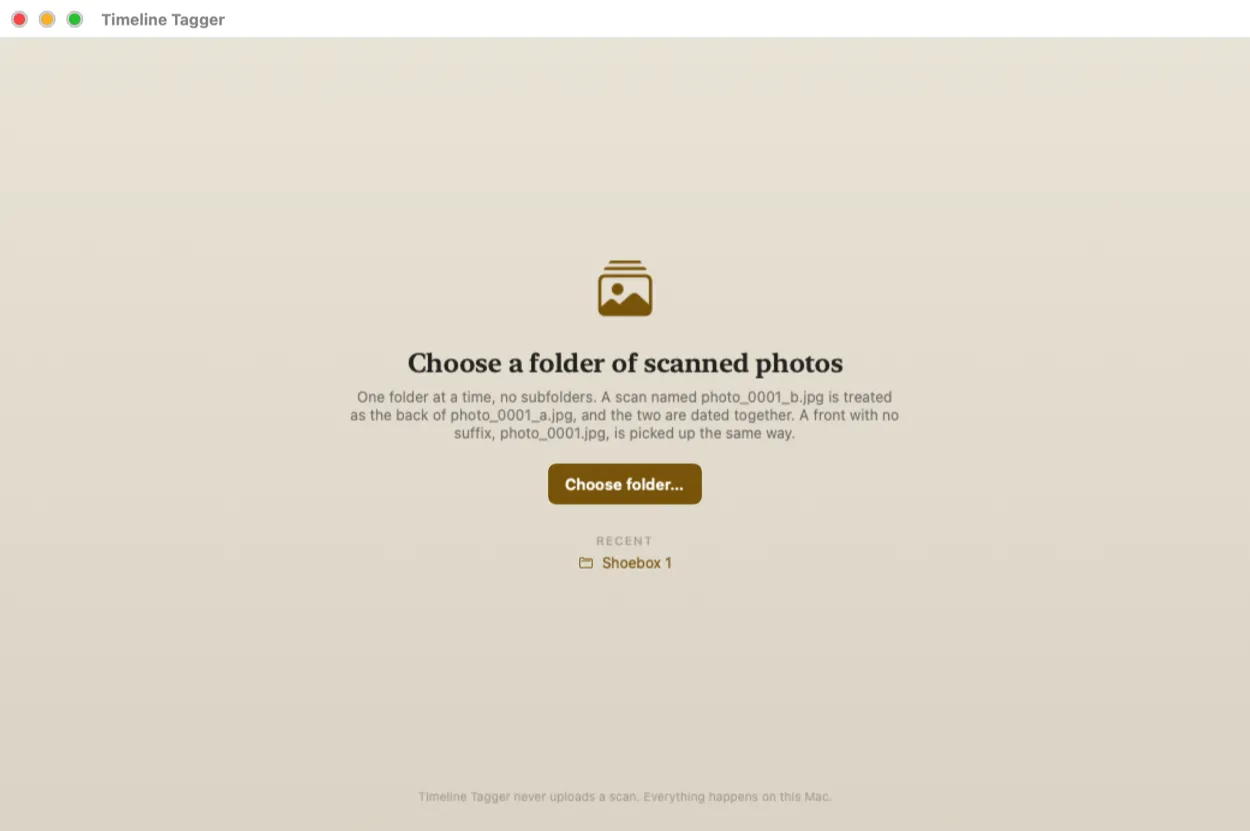
The Timeline Tagger welcome screen: a Choose folder button, a line explaining that photo_0001_b.jpg is treated as the back of photo_0001_a.jpg, and a recent folder called Shoebox 1
One folder at a time. Subfolders are left alone, and the folders you have opened before are one click away.
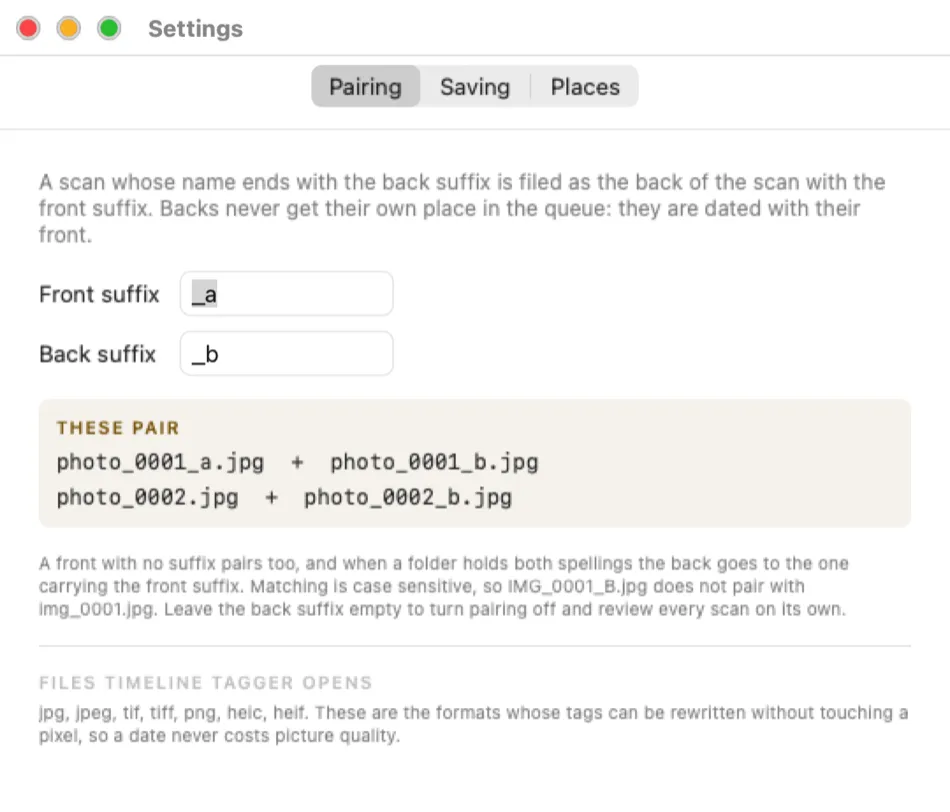
The Pairing pane of Timeline Tagger settings, with the front suffix set to _a, the back suffix set to _b, and a worked example showing which filenames pair
Pairing lives in Settings. Out of the box _b marks a back, and a front with no suffix pairs the same way.

Guide one

Date a Photo, Front to Back

The whole app is this loop. Read the back, type the year, press Return.
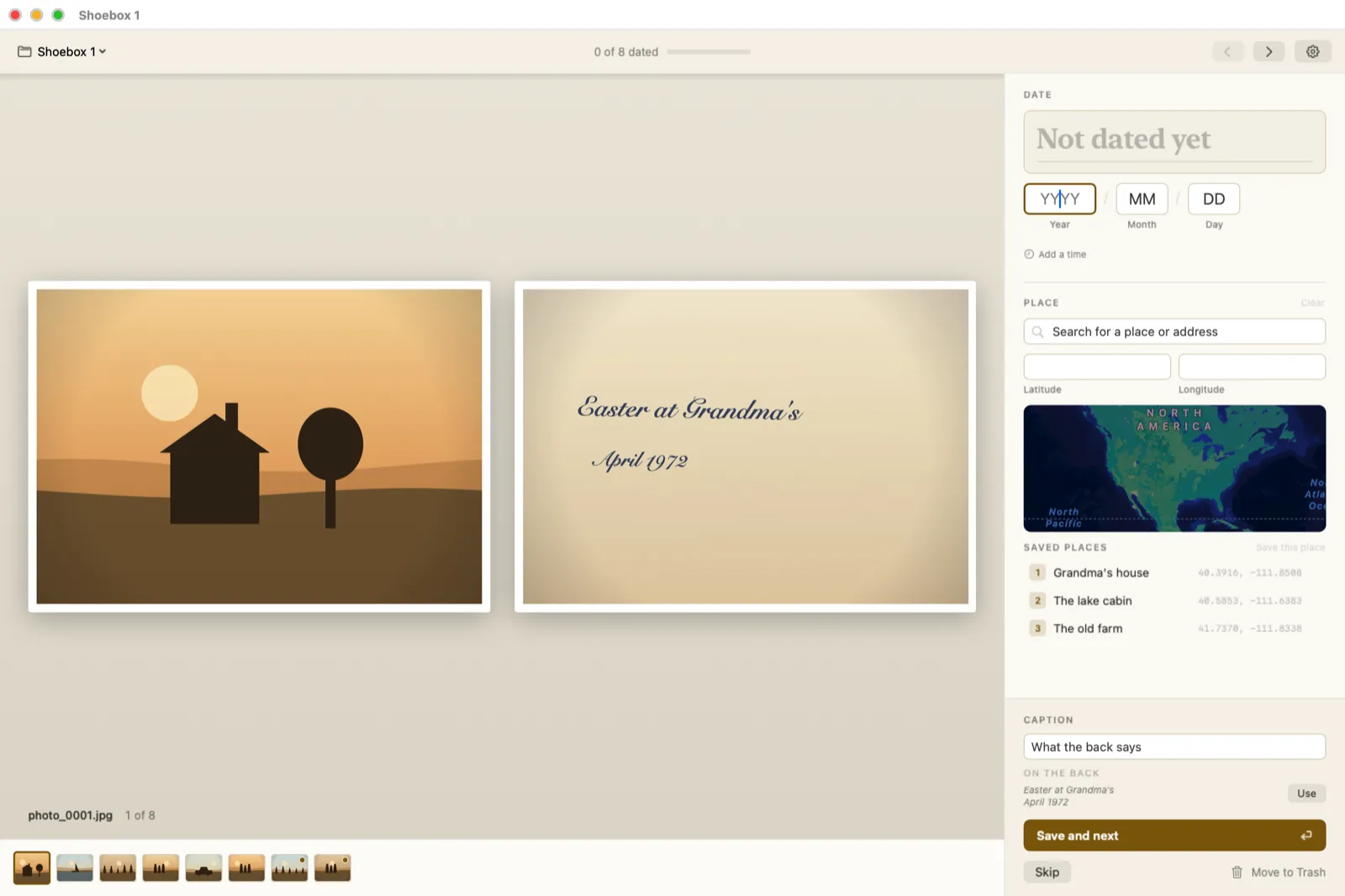
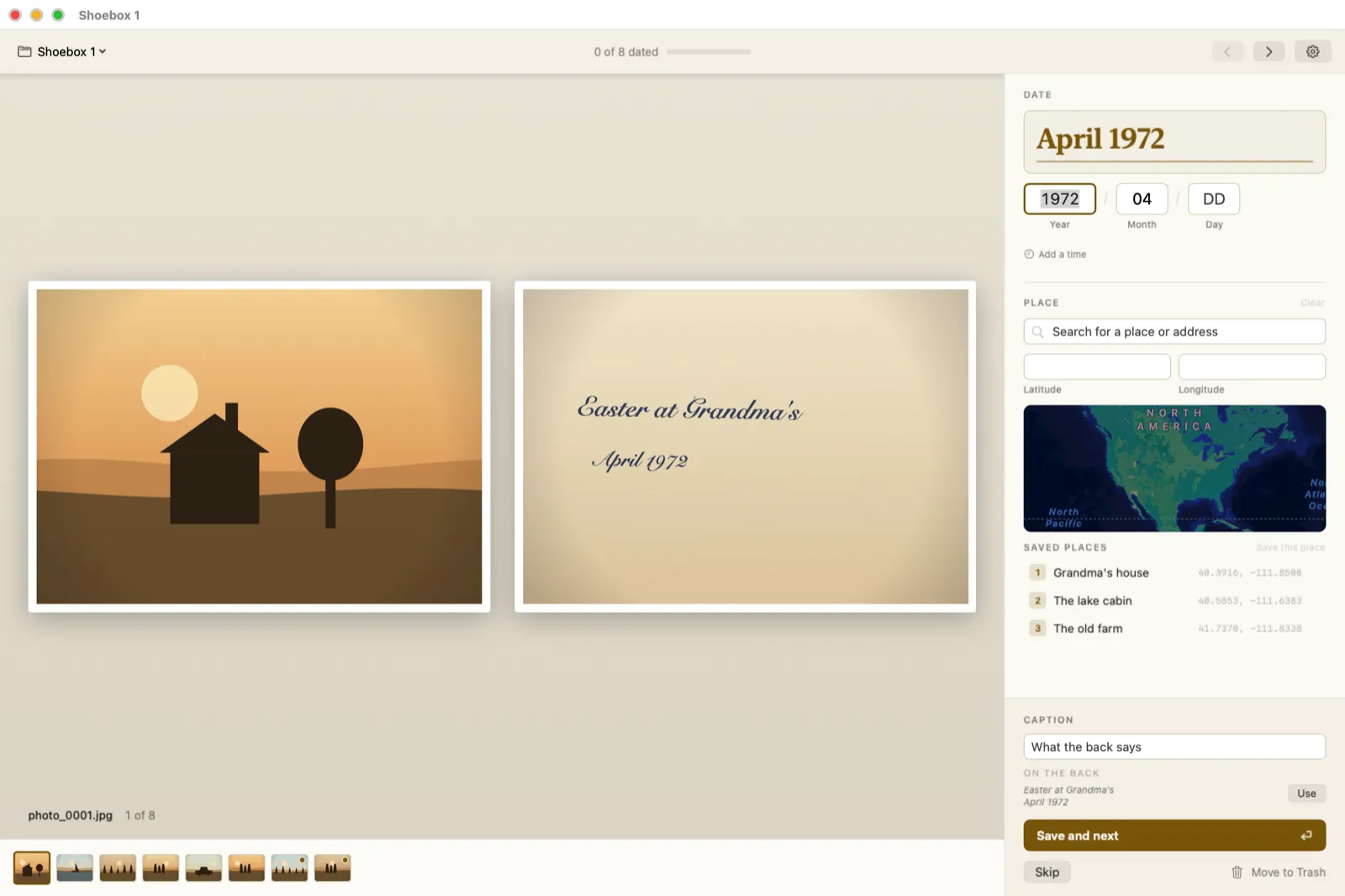
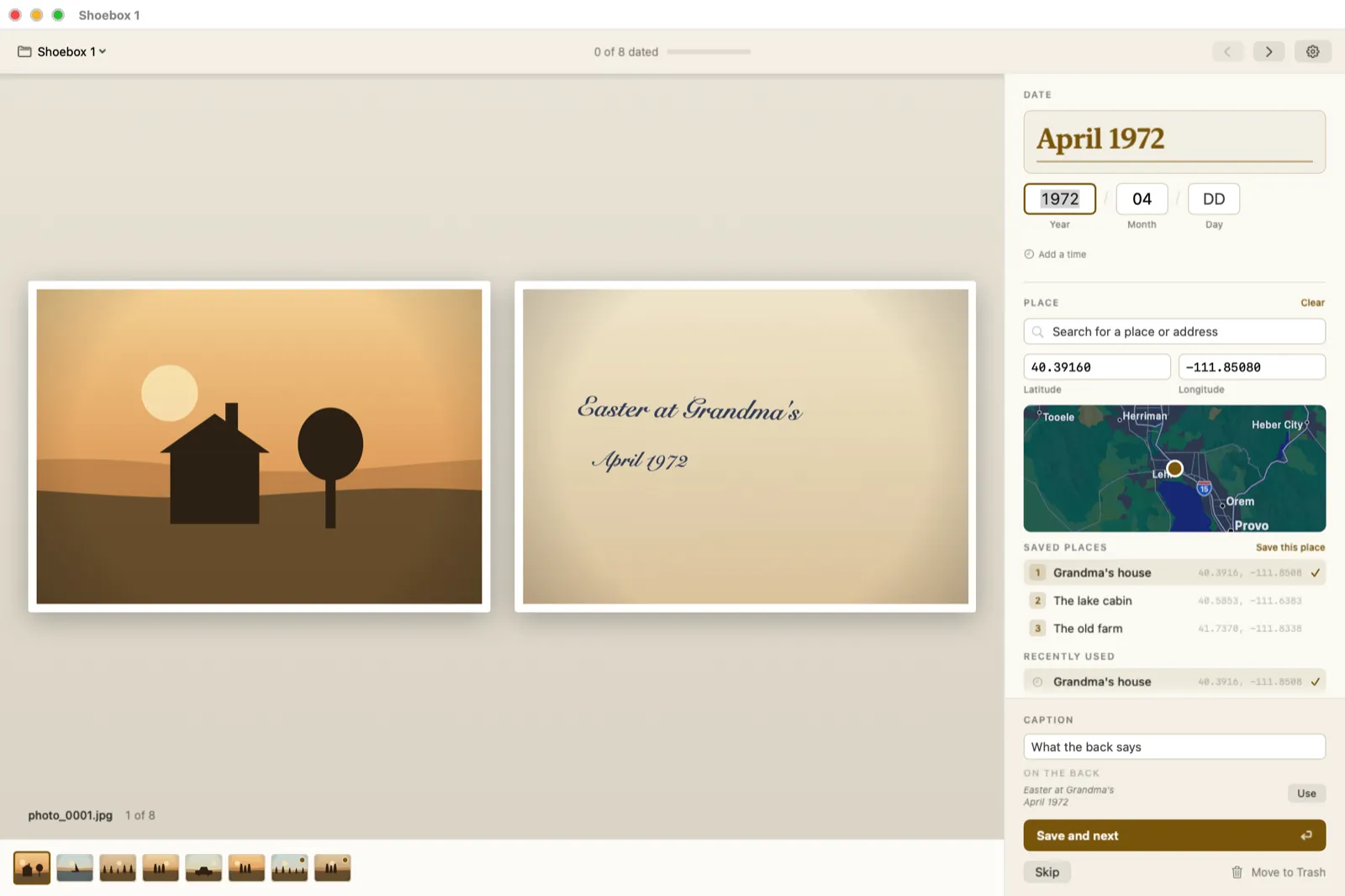
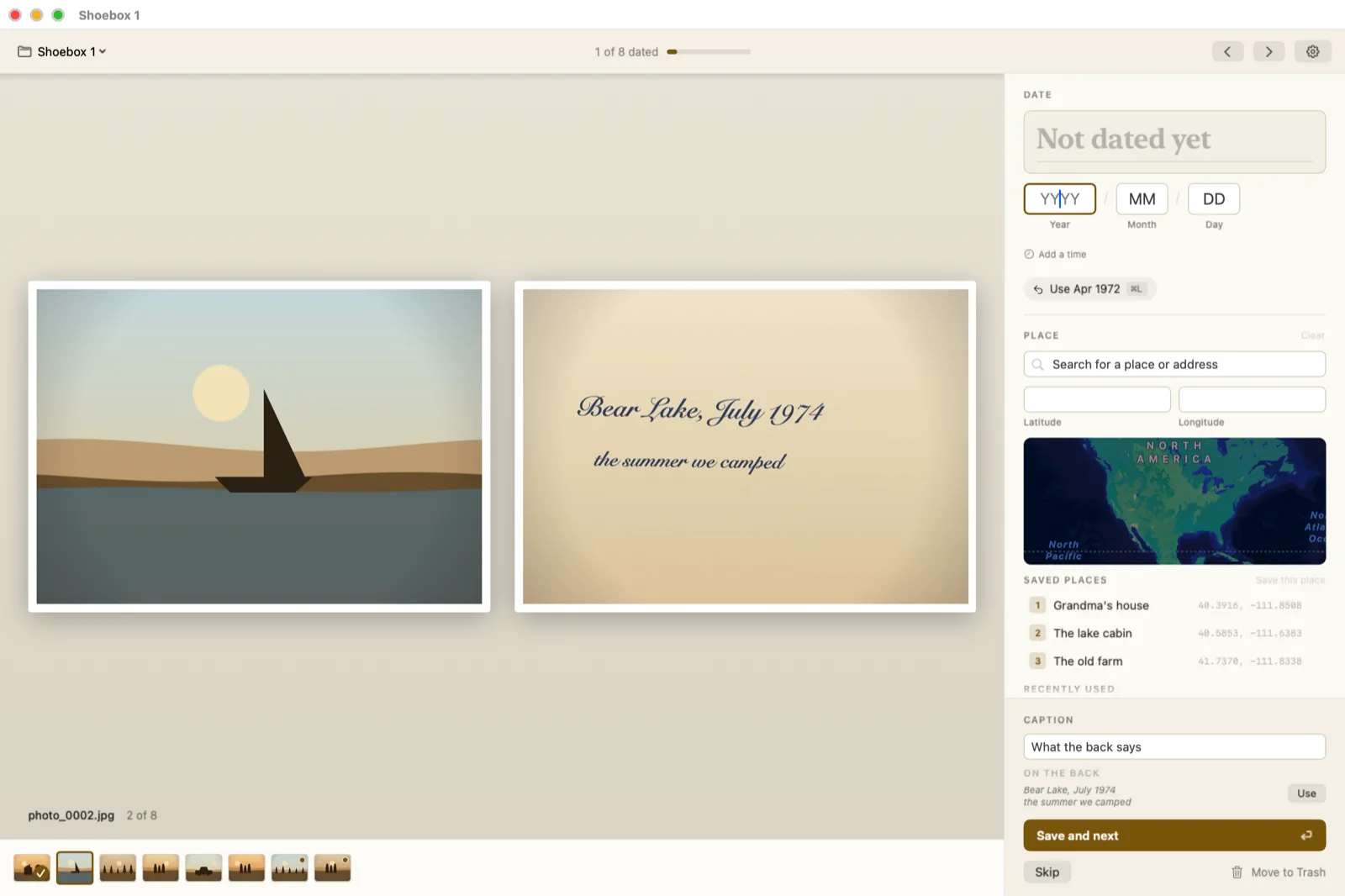
Timeline Tagger with the first scan and its handwritten back lying side by side, and the date panel reading Not dated yet The same photo with 1972 in the year box and 04 in the month box, and the stamp above them reading April 1972 The place panel filled in: coordinates in the two fields, a pin on the small map, and the saved place Grandma's house checked The next photo on the table, the progress bar reading 1 of 8 dated, and a check stamped on the first thumbnail in the filmstrip

Guide two

Let It Read the Back

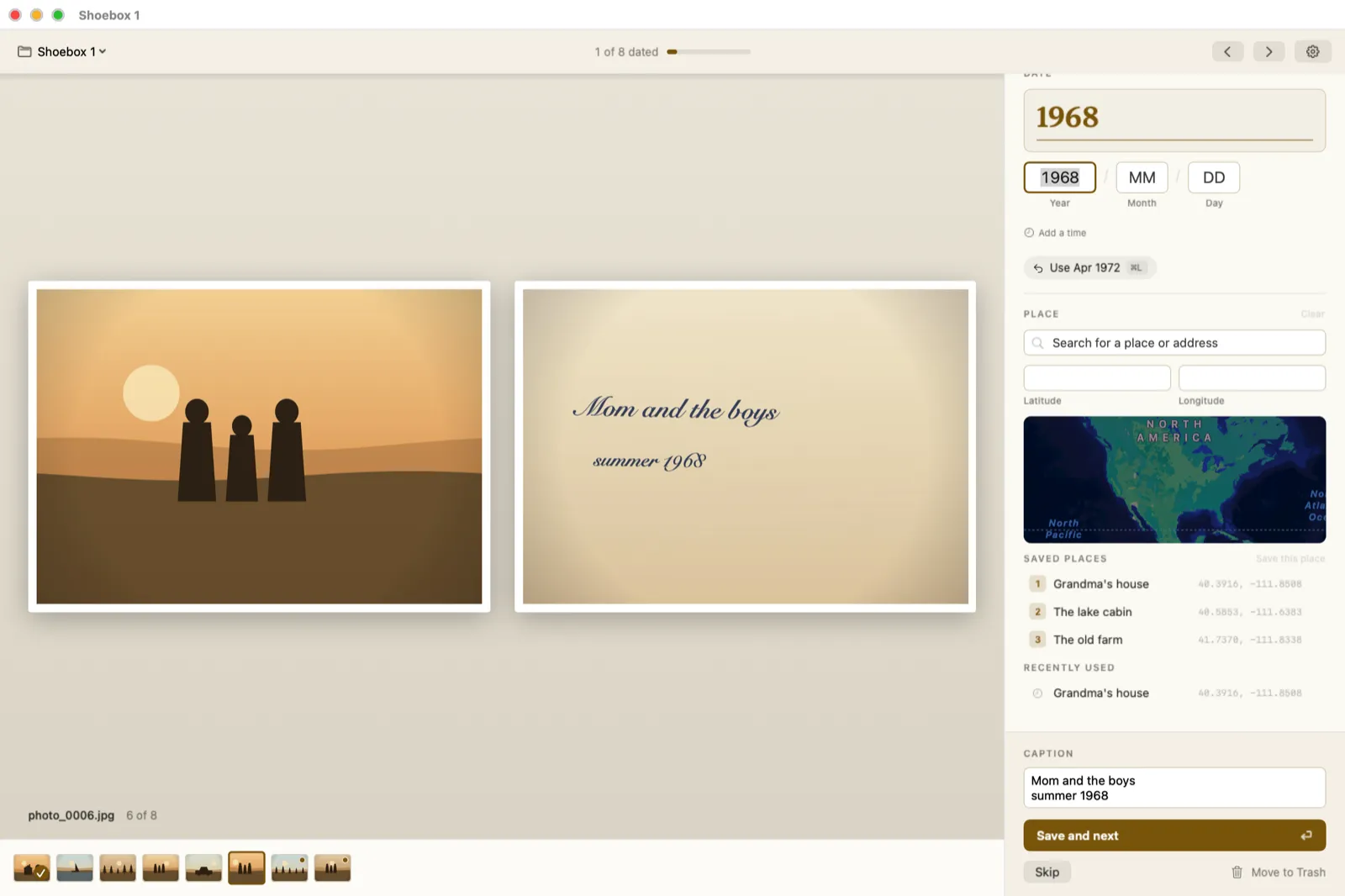
The handwriting is why the back is on screen at all. The app reads it here on your Mac and offers what it found.
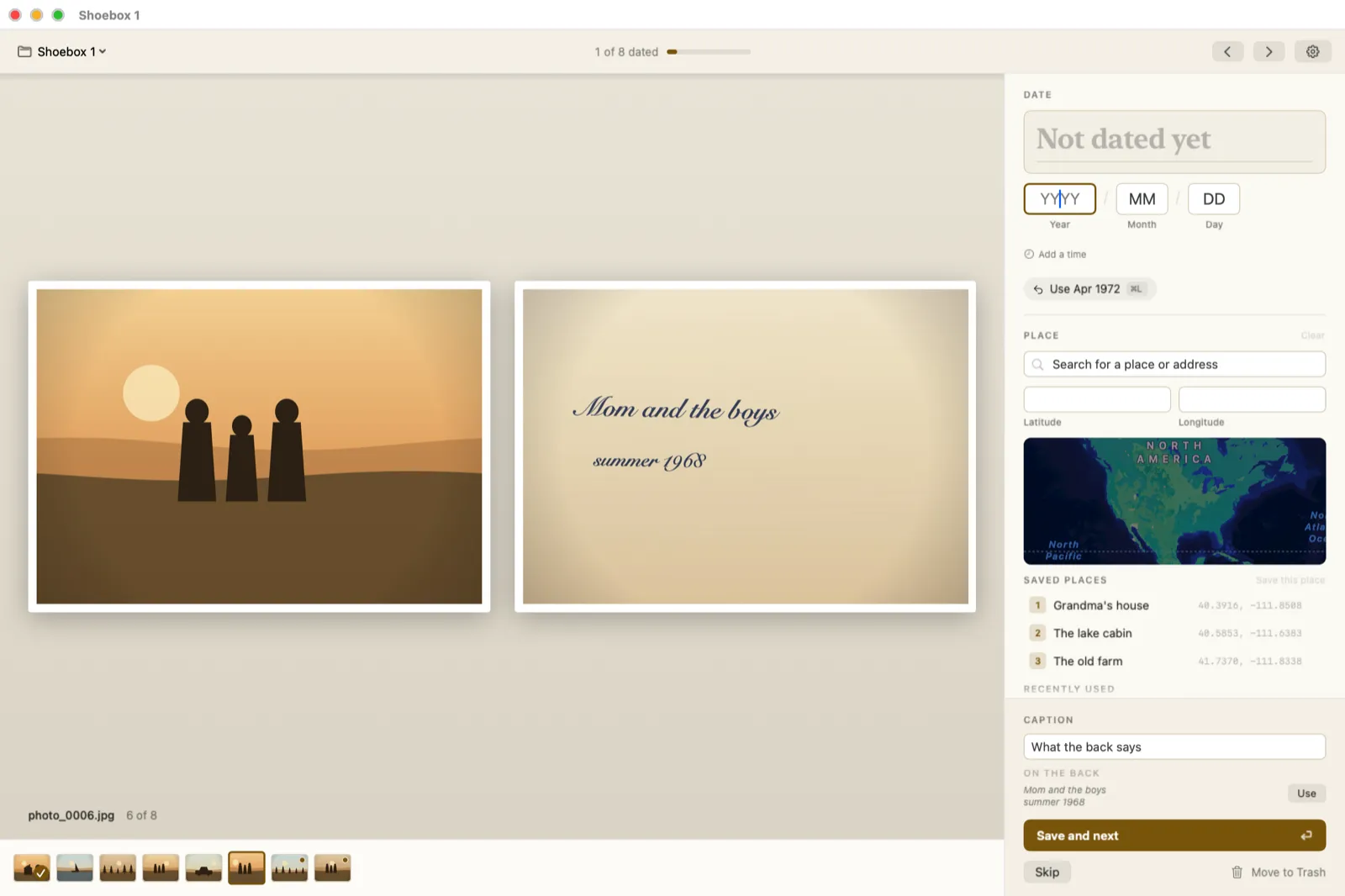
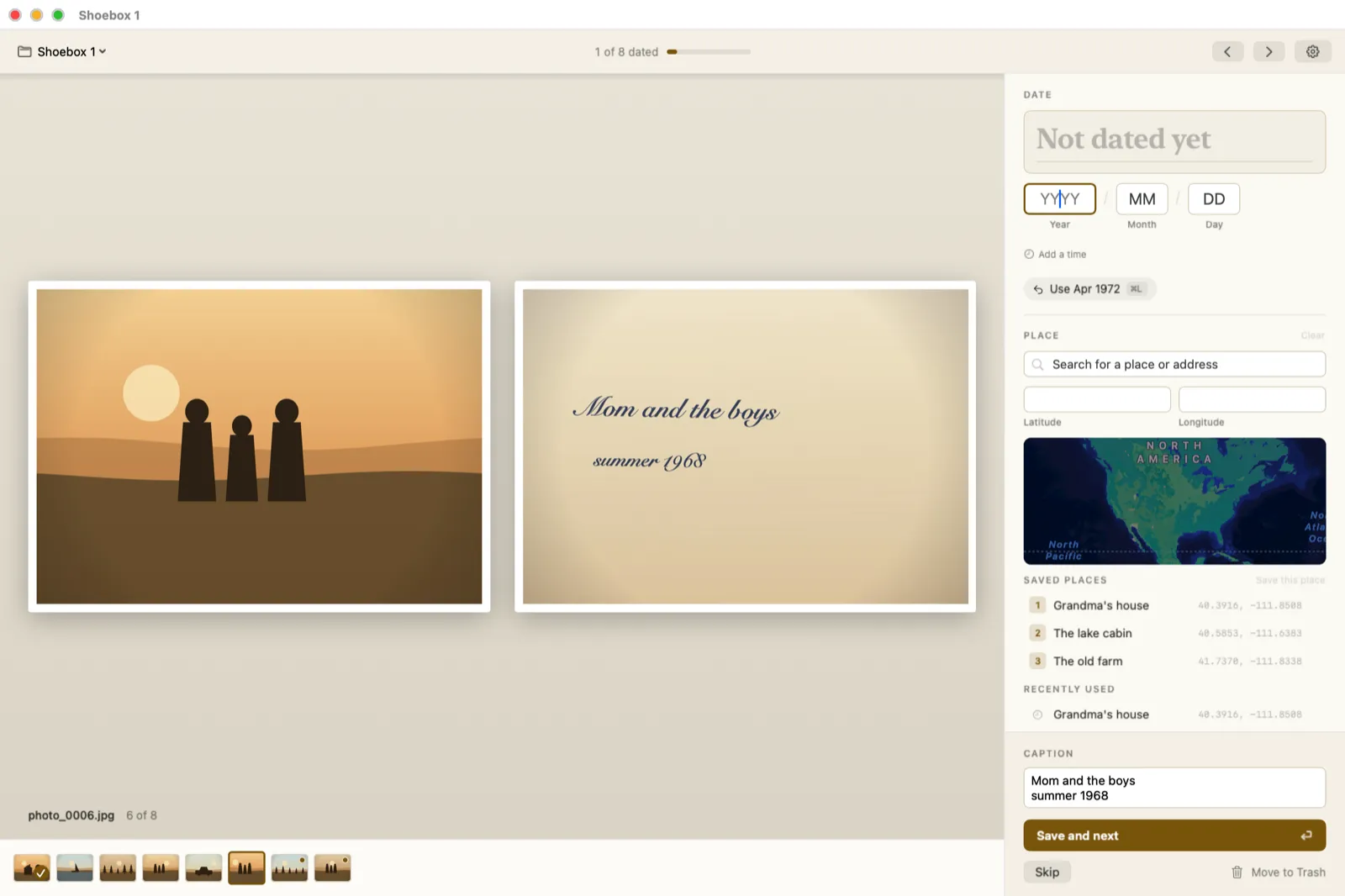
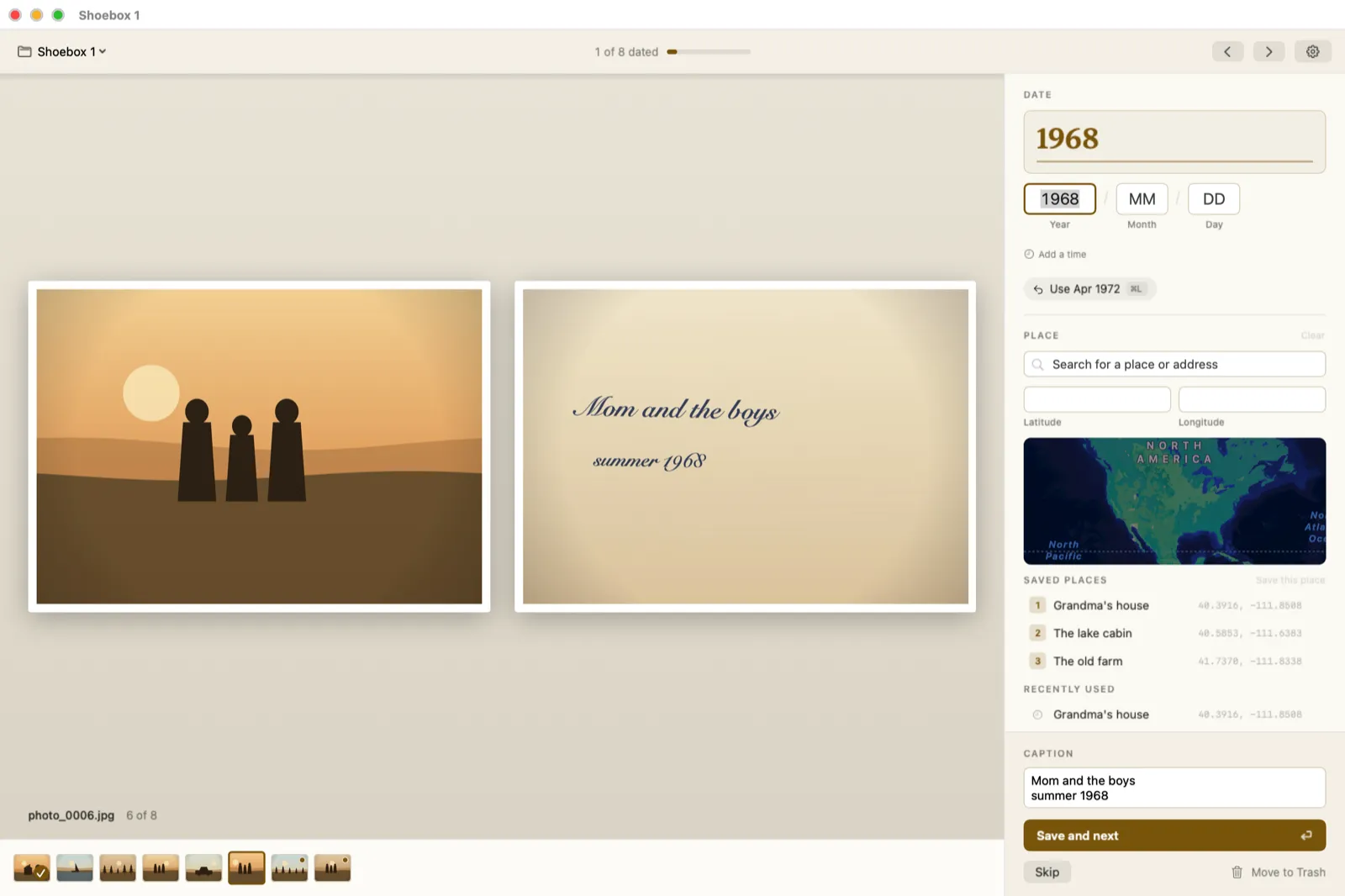
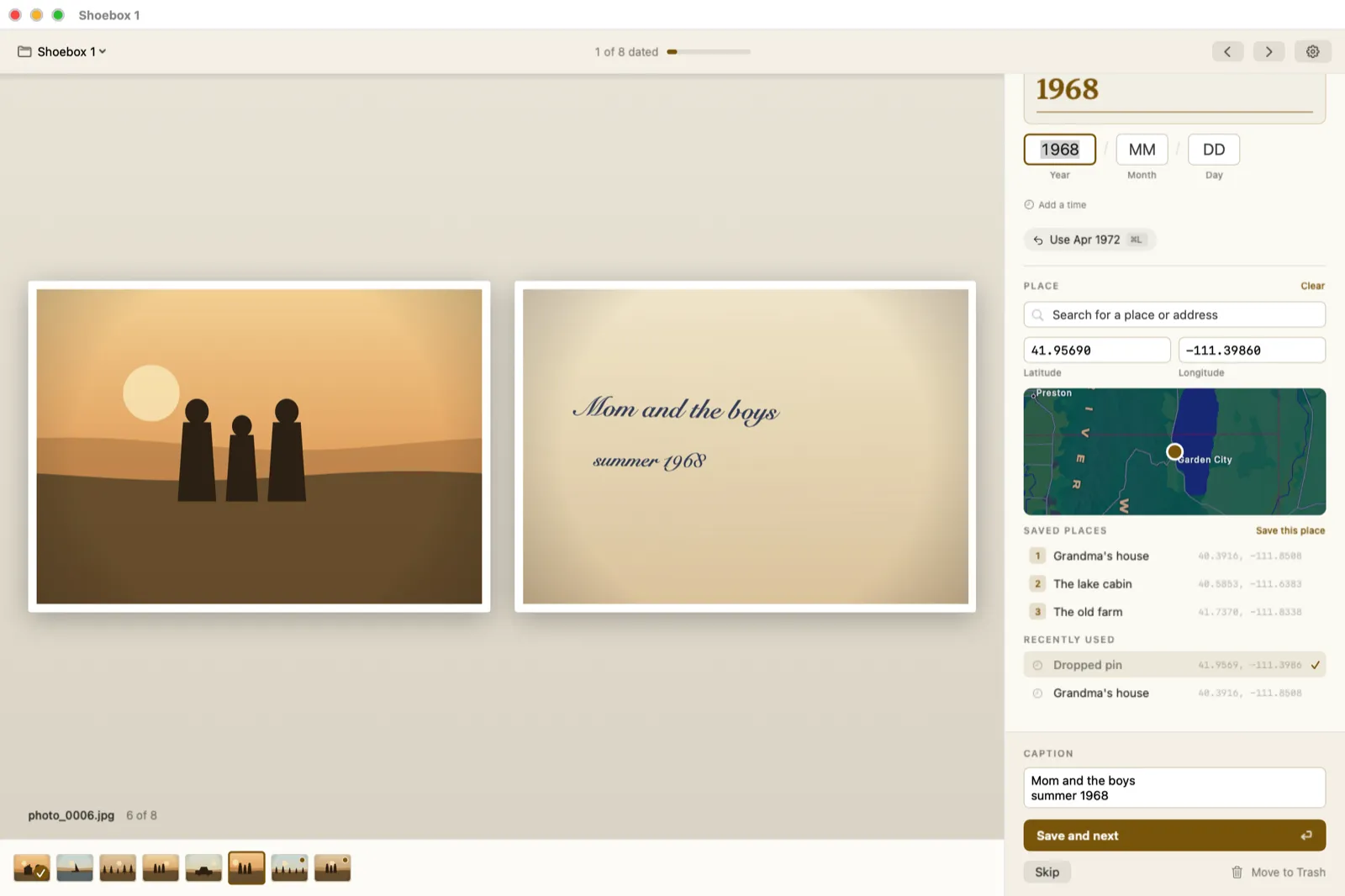
A scan beside its back, which reads Mom and the boys, summer 1968. The same words appear under the caption field beneath the heading ON THE BACK, with a Use button The caption field now holding the two lines read off the back, and the suggestion row gone The year 1968 typed into the year box, with the stamp reading 1968 and the month and day boxes left empty

Guide three

Set the Place Fast

Half a shoebox was taken in the same three places. Name each one once, then it is a single key after that.
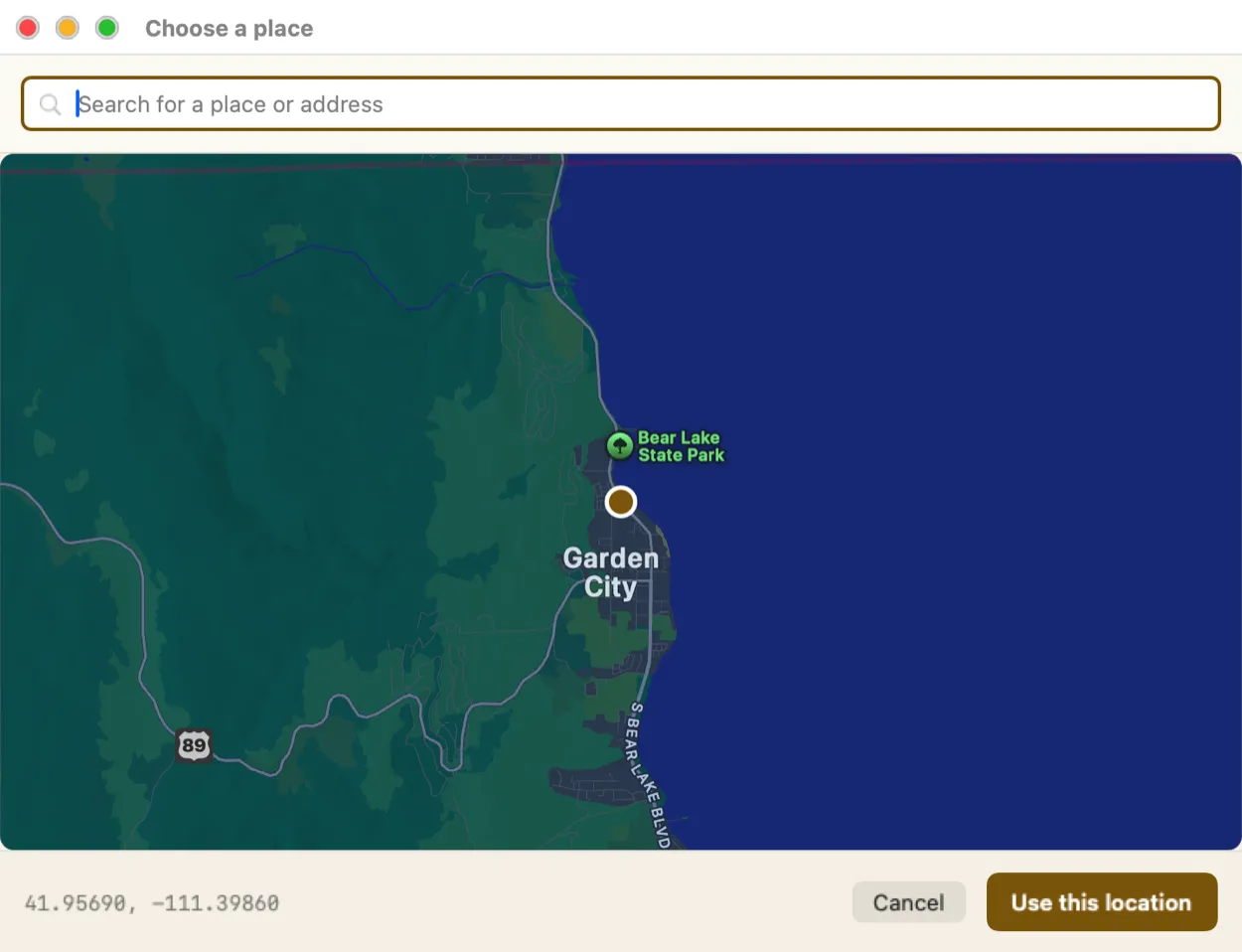
The place panel with nothing pinned: an empty search box, empty coordinate fields, a map zoomed out to the whole country, and three saved places numbered 1, 2 and 3 The big map picker open over the app, showing Bear Lake and Garden City with a pin dropped beside the shore, the coordinates in the bottom left and a Use this location button The place panel with the pin kept: coordinates filled in, the small map centred on it, and a checked Dropped pin row under Recently used

Guide four

Look Closer, Turn Things

Backs go through a scanner whichever way up they land. Each side turns on its own, and no pixel is re-encoded.
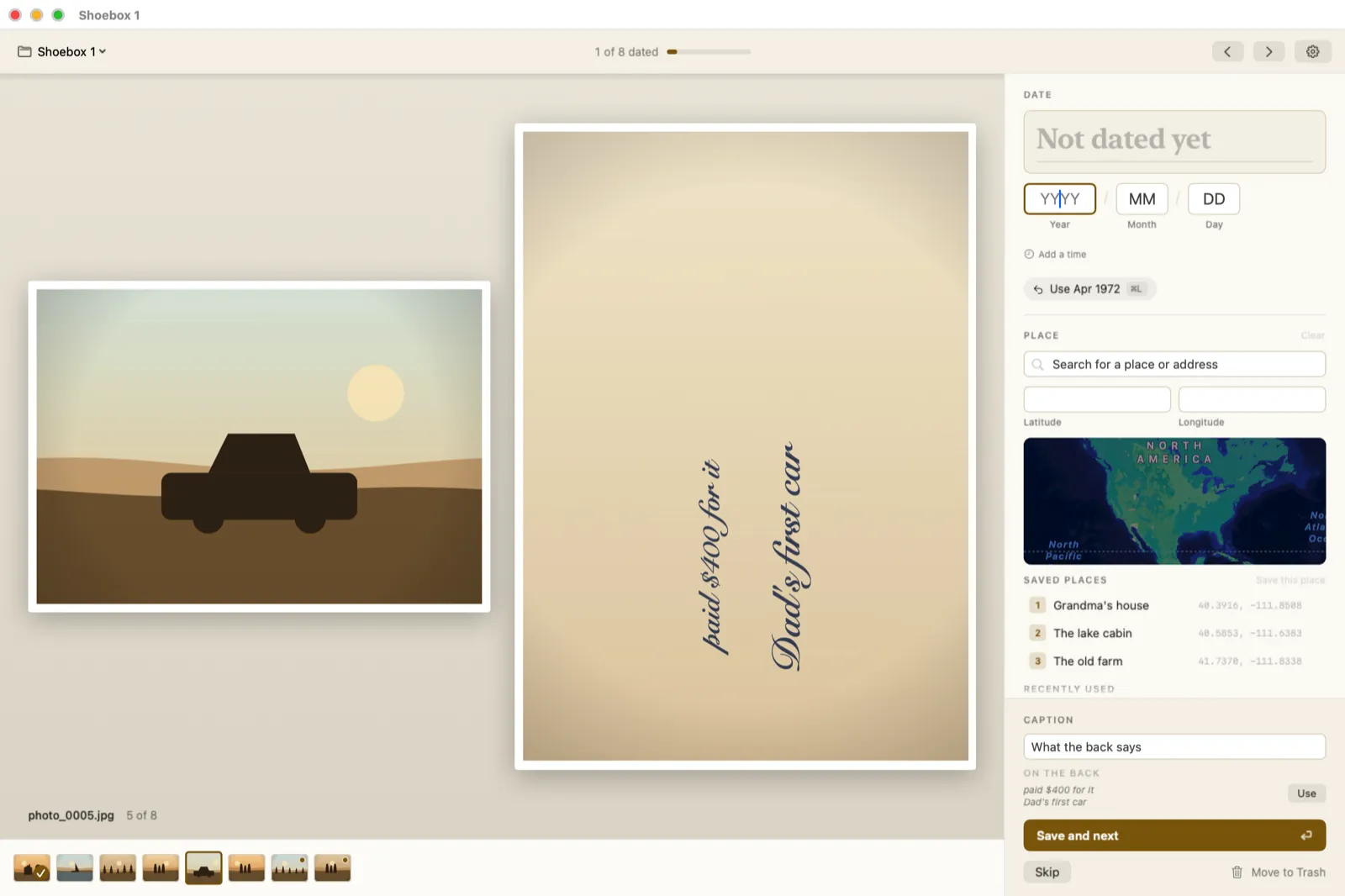
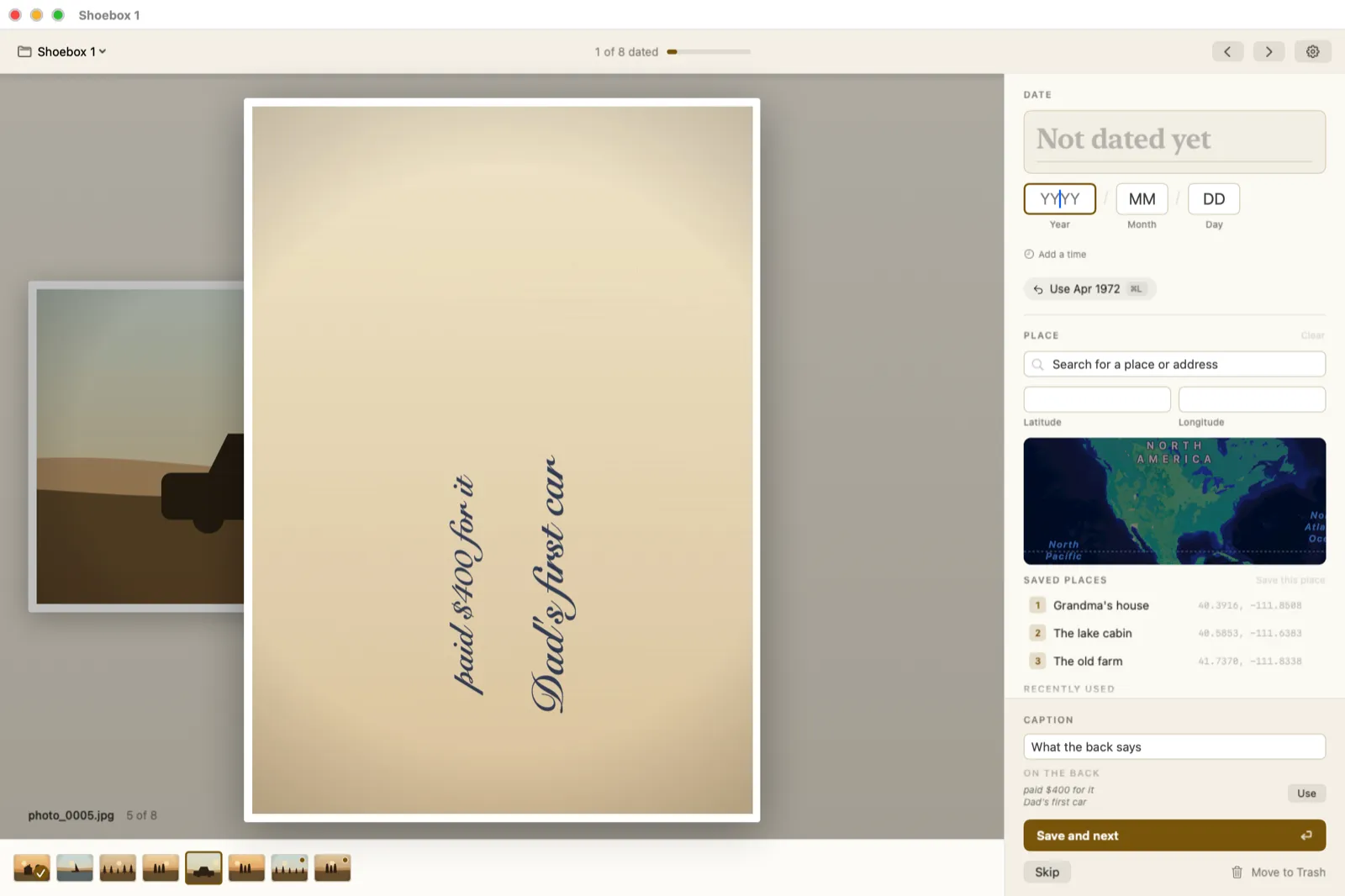
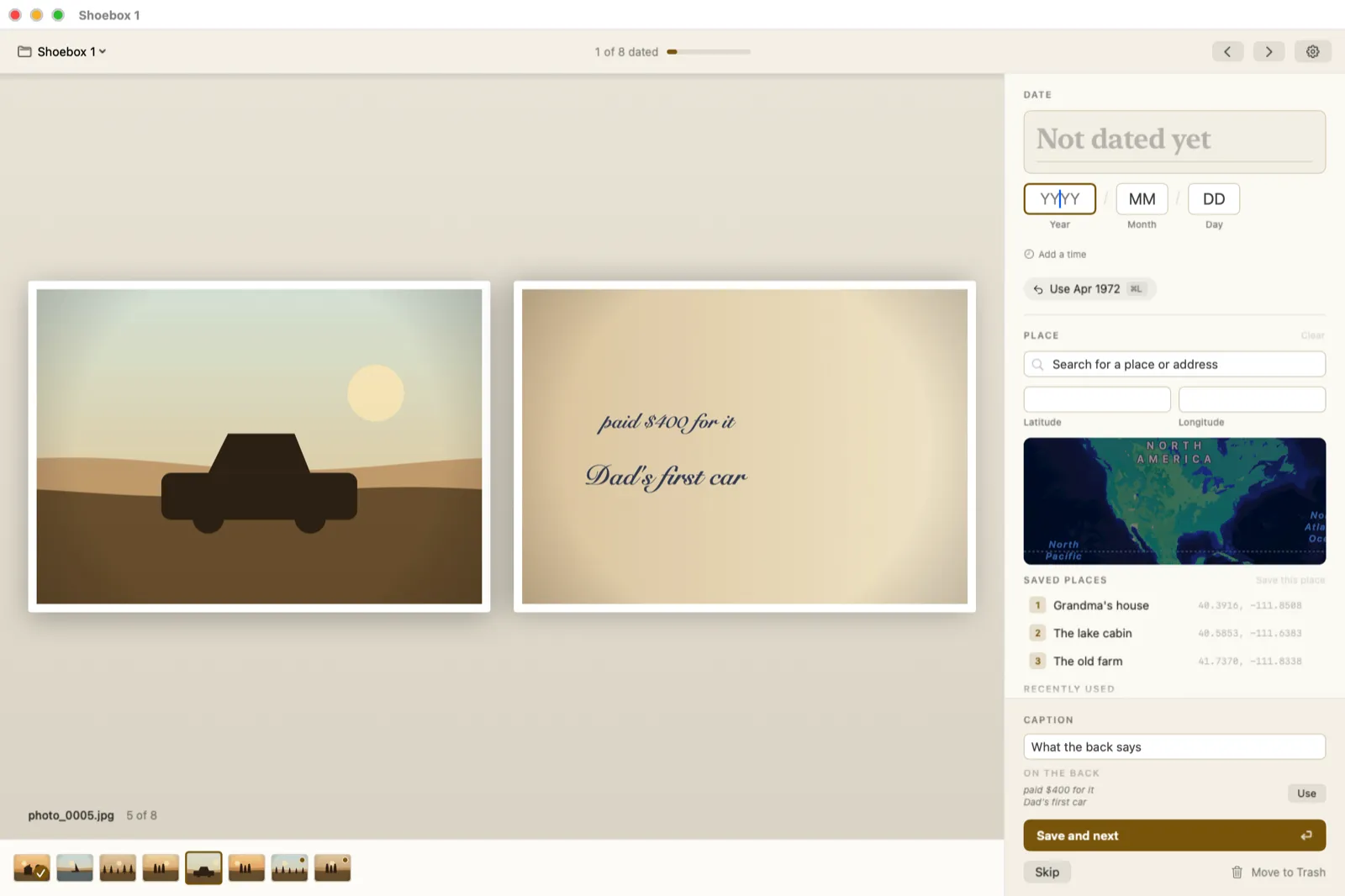
A photo of a car beside its back, whose handwriting runs up the page because the back was scanned sideways The back lifted over a dimmed table, filling the stage, with the front greyed out behind it Both prints flat again, with the back turned a quarter so its handwriting reads across the page while the front is untouched

Two close-ups

What the Marks Mean

The filmstrip along the bottom and the date panel at the top of the card carry most of what the app is telling you.

A close-up of the filmstrip: eight thumbnails, the first with a check disc, the third dimmed with a dash, the sixth ringed in amber as the current photo, and the last two carrying small amber dots
The filmstrip. A check is one you dated this session, a dimmed dash is a skip, the amber ring is where you are, and a small amber dot means the file already carried a date.
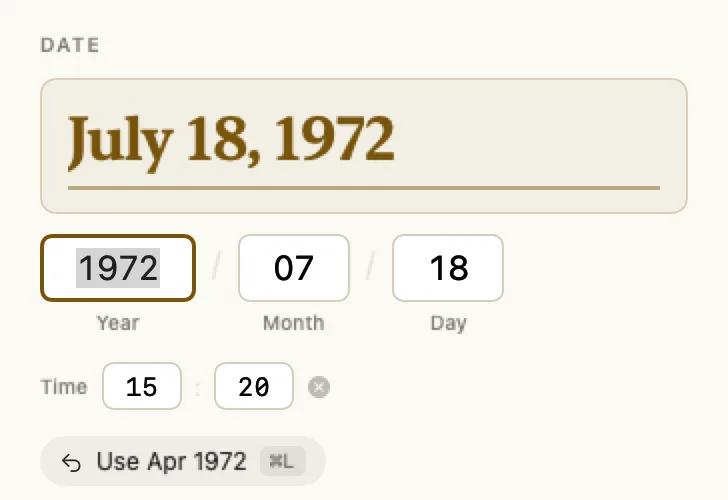
A close-up of the date panel: a large serif stamp reading July 18 1972, the year month and day boxes, a time row holding 15 and 20, and a chip reading Use Apr 1972 with the Command L shortcut
The date panel. The stamp is what will be written, month and day may stay empty, and the time row only appears when you ask for it.

Reference

Every Keyboard Shortcut

The menu bar carries all of these too. Ten seconds a photo is the difference between using the keys and reaching for the mouse.

Wherever the caret is

⏎ ReturnSave this photo and bring up the next
⌘OChoose a folder of scans
⌘LFill in the last date you saved
⌘RTurn the print right
⇧⌘RTurn the print left
⌘ZUndo the last save
⇧⌘ZRedo it
⌘[Previous photo
⌘]Next photo
⌘⌫Move this scan and its back to the Trash
⌘,Settings

With no field selected

1Apply the first saved place, up to 9 for the ninth
Previous photo
Next photo
EscPut a lifted print back down

While you are typing

⌫ DeleteIn an empty month, day, hour or minute box, step back to the box before it
⏎ ReturnIn the place search, look the place up instead of saving

The caret starts in the year box on every photo, so a digit typed there is part of the year, not a place.

If something is off

Five Things People Ask

The backs are not pairing In Settings ▸ Pairing, the back suffix has to match your filenames exactly, and matching is case sensitive. A front with no suffix pairs too, so photo_0001.jpg still picks up photo_0001_b.jpg.
The map is blank Map tiles and the place search are the only parts that need the internet. Coordinates typed into the two fields work offline.
macOS will not open it The app is signed and notarized by Apple, so it opens without a security prompt. Drag it out of the disk image into Applications first, then open it from there.
Where the copies went In copy mode the stamped file keeps its filename and lands in the folder chosen under Settings ▸ Saving. The scans in your source folder are not touched.
Undoing a save Press ⌘Z any time in the session and the old tags go back exactly as they were. A pair you moved to the Trash comes back the same way.